
Every major sport was niche at one point.
The NFL wasn't always America's king. The NBA once contained only eight teams. Even the UFC was once banned in multiple states.
That's the idea behind Mike Tries Sports.
Every week, I'll watch a sport that's trying to break through into popular culture, dig into the business behind it, and answer one simple question:
Can this become mainstream?
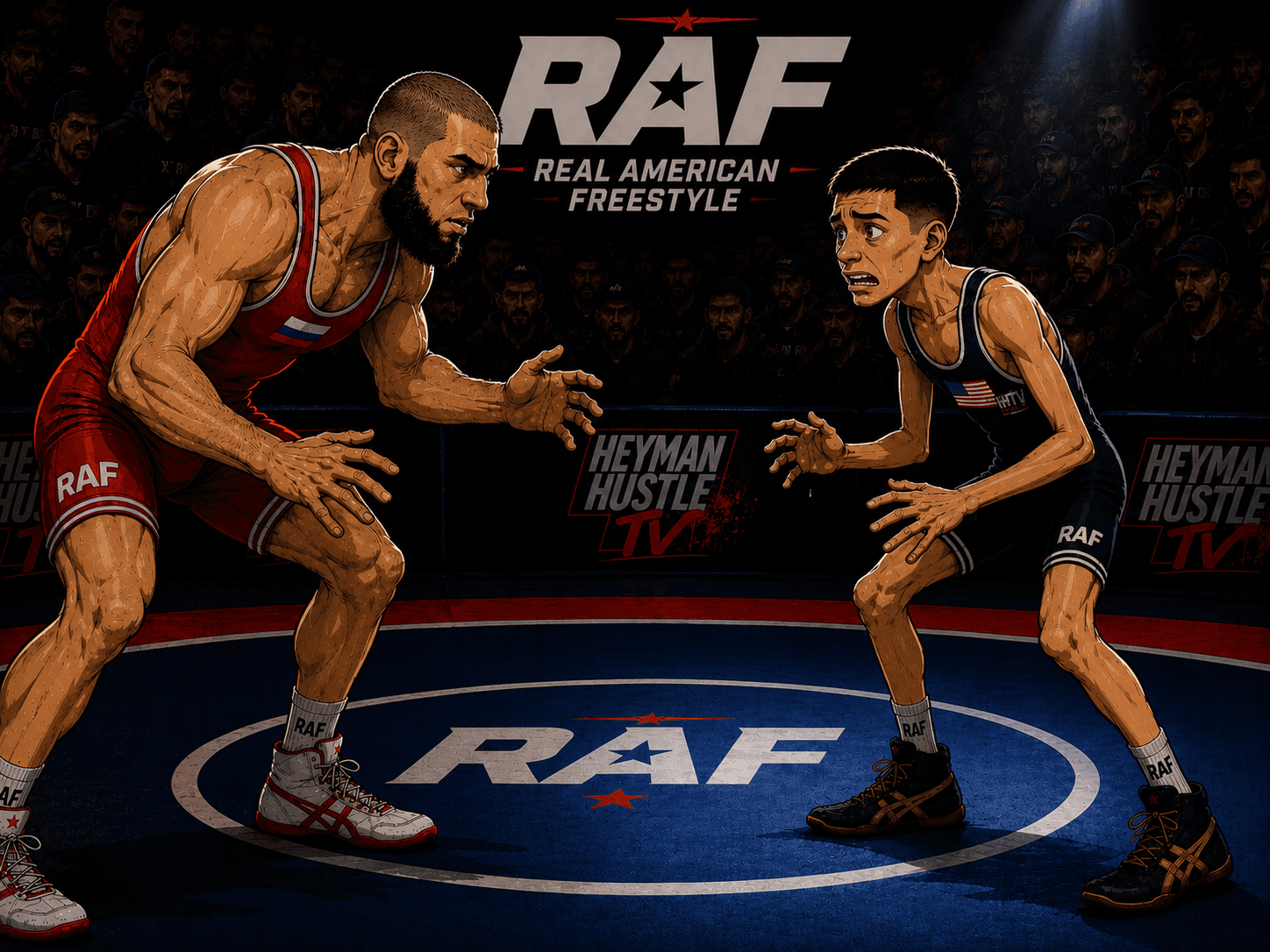
This week's candidate was Real American Freestyle Wrestling, or RAF, and after watching RAF 10 this past Saturday, I think we may be off to a great start.
If you saw anything from the event online, chances are it didn't have anything to do with wrestling.
The main event featured UFC superstar and former middleweight champion Khamzat Chimaev taking on professional agitator Dillon Danis. Chimaev dominated the match, pinning Danis in under a minute.
But the match itself quickly became an afterthought when Danis, the multiple-time Brazilian Jiu-Jitsu World Champion, pulled an illegal wrist-high guillotine choke on Chimaev, sparking a full team-versus-team brawl and forcing both security and promoters to step in to break it up.
The clips spread like wildfire across social media almost instantly.
For casual viewers, the brawl became the story. For me, it became the reason to look deeper into this new spectacle.
The question isn't whether Khamzat Chimaev can beat Dillon Danis in a wrestling match. We all know he can. The question is whether Real American Freestyle has the ingredients to become a mainstay in the sports world.
And surprisingly… the answer might be yes.
RAF 10 was easily the biggest card the promotion has produced to date. Beyond Chimaev and Danis, the event featured names like Arman Tsarukyan, the No.1 ranked UFC lightweight; former UFC interim lightweight champion Tony Ferguson; accomplished wrestlers; rising prospects; and championship bouts. It felt less like a local wrestling event and more like a legitimate combat sports card.
That distinction is one of the biggest problems amateur wrestling has faced. While events like the Olympics and NCAA Championships carry prestige, what they lack is presentation.
The athletes are elite. The competition is legitimate. But the product itself has historically struggled to attract casual sports fans.
RAF is doing things differently.
Instead of asking audiences to care about wrestling because wrestling is important, the promotion is attempting to create stars, rivalries, and moments that make people want to watch.
The goal is not only to pique people's interest, but to then get them to reach into their pocket and pay to watch the product.
It's a strategy taken directly from the UFC's playbook. And that's where this becomes interesting.
So what makes RAF different from the dozens of startup sports leagues that come and go every year? The short answer is that it already has things most startups spend years trying to get:
Recognizable leadership. Co-founded by pro-wrestling icons Hulk Hogan and Eric Bischoff, the front office isn't exactly a stranger to building both audiences and in-house personalities.
Legitimate investment. Backed by real venture capital and already on pace for eight-figure revenue this year, RAF is being built like a business, not a passion project.
National distribution. A long-term FOX Nation streaming deal gives RAF the kind of national reach — and media-rights revenue — most startup leagues never get near.
Betting ecosystem. It recently partnered with ALT Sports Data, putting its events into the sports betting ecosystem alongside established sports properties.
None of those things guarantees success, but they tell me something important:
The people behind RAF aren't treating this like a one-off event series. They're building something real, something built not just to survive, but to scale.
Because wrestling itself isn't the problem: America already produces world-class wrestlers. College wrestling draws passionate crowds. Olympic wrestling has produced legends. The audience exists. And RAF is already reaching it — the promotion is pulling 250 to 300 million views every month.
It also isn't a lack of name value, either.
RAF has featured MMA fighters like Colby Covington, Merab Dvalishvili, Henry Cejudo, Urijah Faber, and Benson Henderson, among others mentioned earlier.
The organization is also tapping into the influencer world, featuring the likes of Georgio Poullas, and most recently booking a match between The Real Tarzan and Larry Wheels.
The biggest question is whether RAF can create in-house stars who aren't already famous, whether that be from MMA or from something else.
Can fans become invested in championships? Can new stars emerge? Can viewers tune in because they care about RAF itself rather than simply recognizing a UFC name on the poster?
Those are difficult questions.
They are also the questions every emerging sports league eventually has to answer.
The NFL didn't become the NFL because of one game. The UFC didn't become the UFC because of one pay-per-view.
Mainstream sports become mainstream because they consistently create stars, stories, and moments, giving fans reasons to keep coming back.
Will Real American Freestyle ever sit at the same table as the NFL, NBA, MLB, NHL, UFC, WWE, or global soccer?
Maybe. Maybe not.
But after watching RAF 10, I came away more optimistic than skeptical.
Mike's Verdict: BUY
Real American Freestyle isn't mainstream yet.
But it has more momentum, infrastructure, and long-term potential than most emerging sports properties I've come across.
The Chimaev–Danis brawl generated headlines, but the bigger takeaway from RAF 10 was that this feels like a company building for the future, not just chasing viral moments.
There are still questions. The promotion needs stars beyond crossover MMA/celebrity names. It needs championship matches that casual fans care about. And it needs to prove that people will keep watching once the novelty wears off.
But unlike most startup leagues, I can actually see the path.
It's not about reinventing the wheel; it's about fixing a sport that has been broken for years.
And I believe RAF is capable of doing so.
I'm buying.
What's YOUR Hustle?
Follow Mike Ferrante on Instagram!
Did you watch RAF 10? Let us know on @HeymanHustleTV!