

For the past two years, every major tennis tournament, also known as Grand Slams, has ended with one of the same two names hoisting the final trophy — Jannik Sinner or Carlos Alcaraz.
This year though, Roland Garros, aka the French Open, lost the two top stars within the first week.
Roland Garros, widely recognized as the most punishing tournament, is the only major played on clay — the slowest and most grueling surface in the sport, where points stretch long and matches are won on legs and lungs as much as raw talent.
Alcaraz pulled out with a pre-tournament wrist injury, while Sinner went down in the second round, after a cramping battle left the Italian drained, exhausted, and out of his element.
The elimination of Sinner (world No.1) marked uncharted territory for tennis — the first time since 2000 that the No.1 player in the world failed to reach the 3rd round of Roland Garros.
The French Open was not just open… it was WIDE OPEN.
With the stars gone, the biggest "ad in" of the whole tournament turned out to be youth itself. And without a doubt, the youngsters stepped up to the plate.
It started at home. Moïse Kouame, a 17-year-old French wild card, meant nothing to most fans when the tournament began, but that didn't affect him one bit — if anything, it was motivation. His explosiveness, speed, and touch lit up the Paris crowd that quickly adopted him, surging into the third round and becoming the youngest man to get there since Rafael Nadal in 2003.
He wasn't alone. Coming from Spain was 19-year-old Rafael Jódar, who a year ago was just another college kid, but has since exploded onto the tour. Jódar won 19 of his first 22 clay matches, a debut run to the quarterfinals, and a nickname already trailing him: the "new Rafa."
Then came the two who turned the youth movement into a headline.
Brazil's João Fonseca, 19, is one of the most electrifying players in tennis, and one of the biggest forehands on tour. Some analysts are already placing him in the same tier as Alcaraz/Sinner — extremely high praise for the youngster.
He produced quality match after quality match, most notably beating the legend, and GOAT by many accounts, Novak Djokovic, in a 5-set thriller. Fonseca came back from 2 sets down to capture the victory in the grueling 4 hour 53 minute match. He followed that by defeating world No.14 Casper Ruud in a 4-set breakdown.
Riding high into the Roland Garros quarterfinals, João was set up for a match destined for fireworks against Czech Republic's surging Jakub Menšík.
Menšík, 20, is the definition of a berserker. Standing 6'5" with one of the best serves on tour, he sawed his way through Roland Garros, defeating Alex de Minaur (world No.8) and Andrey Rublev (world No.11) en route to his quarterfinals match against Fonseca.
The match with Fonseca wasn't exactly competitive, with Menšík dominating the Brazilian in 3 sets — pushing him through to the semifinals, making him the youngest Czech man to do so, and also making him the first man born in 2004 or later to reach a major semifinal.
For the first time this century, three men aged 20 or under (Fonseca, Jódar, Menšík) reached the same Grand Slam men's singles quarterfinal. Historic would be an understatement.
But while the teenagers grabbed the headlines, an entire nation was quietly taking over the other half of the bracket — and not the one you'd expect.
With Sinner (world No.1) going down in round two, and Lorenzo Musetti (world No.16) injured, it fell to the rest of the Italians to make a mark on Roland Garros — and let's just say, they absolutely delivered. By tournament's end, three Italians made the quarterfinals, and two made the semifinals.
Leading the charge was 24-year-old Flavio Cobolli, a man looking to capture Italy's first Roland Garros title since 1976.
Also in the mix were the Matteos — Matteo Berrettini and Matteo Arnaldi — two Italians who by all accounts were not expected to make it this far, and who were both hungry to seize the moment. Unfortunately, injuries plagued both men. Berrettini withdrew midway through the 2nd set against Arnaldi, and Arnaldi himself pulled out with an illness just hours before his semifinal match versus Cobolli, sending Cobolli through to the final without hitting a single ball.
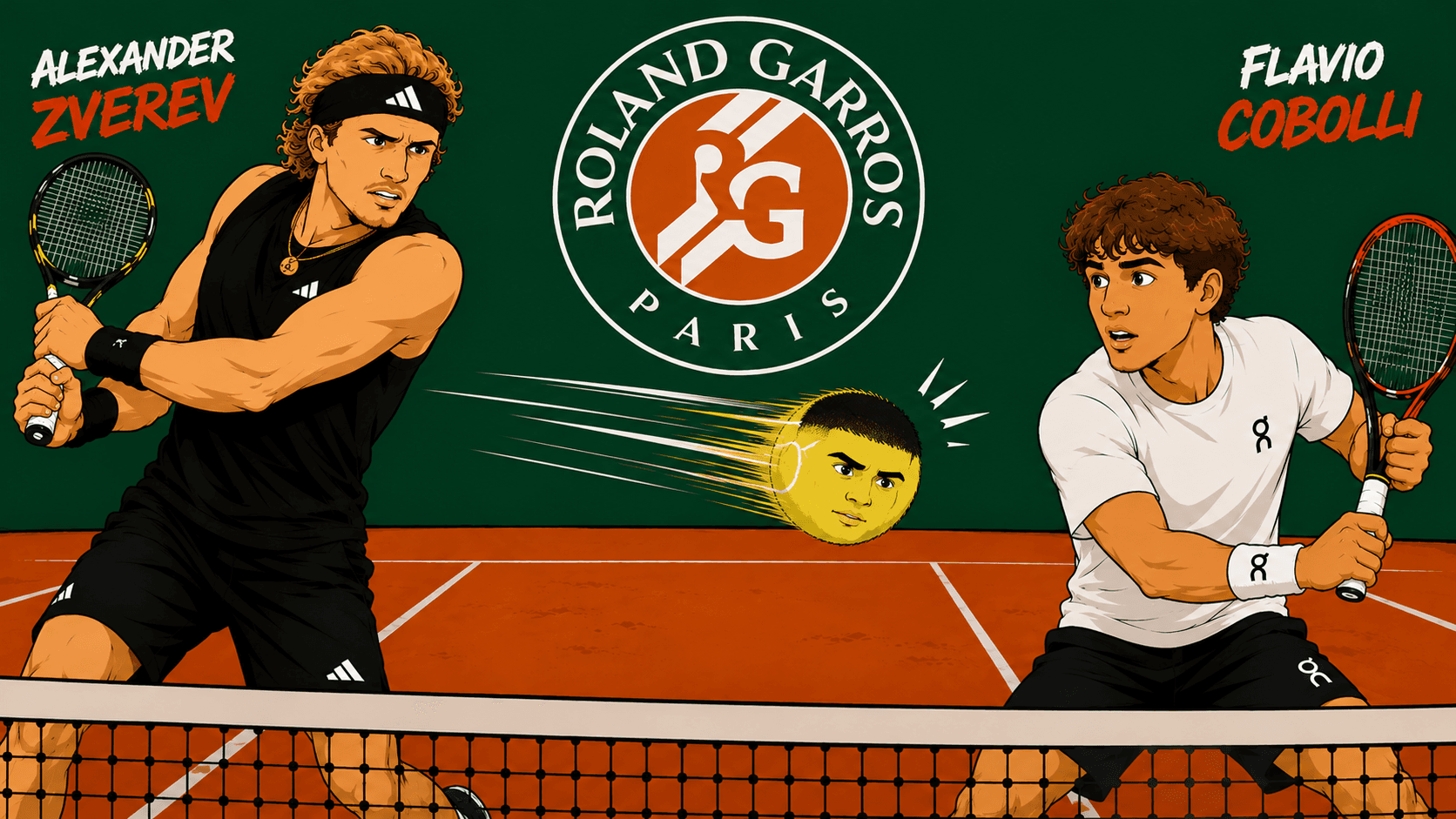
But waiting on the other side of the net was a problem no amount of Italian momentum could solve — the German juggernaut, Alexander Zverev.
With Sinner and Alcaraz gone, Zverev, 29, was the last giant standing, and a sizable favorite (compared to the field) to lift the trophy.
The good thing: Zverev was playing like a man on a mission, only dropping 2 sets in six matches leading up to the final. He had already ended the fairytale of two youngsters — Jódar (beating him in the QFs) and Menšík (beating him in the SFs) — dismantling the youth, one by one, in his quest for greatness.
The bad thing: Zverev still hadn't achieved the pinnacle of success for a tennis player — a major championship. Three times he had reached a Grand Slam final. Three times he'd left without the trophy. This fourth time, though, was different. No Alcaraz. No Sinner.
This was his chance. Maybe his last. Certainly his best.
The only thing standing between him and the trophy — Flavio Cobolli, chasing 50 years of history of his own.
The opening set was a beatdown. 6–1 Zverev. It looked like this would be a short final, but in a shocking turn Cobolli bounced back in set two in a big way, stealing it 6–4. The two traded blows deep into the night, the final feeling more like a heavyweight boxing fight than a tennis match.
Zverev took the third, and the Italian, on the ropes, forced a 4th-set tiebreaker and ultimately won it — taking the match into the 5th and final set. The single biggest set of both men's careers.
As the match pushed past 3 hours, Cobolli's body began to fatigue, and Zverev, stone cold on serve, pulled away — dominating the fifth and final set 6–1 and capturing his first ever Grand Slam championship: the 2026 Roland Garros trophy.
Alexander Zverev was a Grand Slam champion at last, and produced a men's title for Germany for the first time in three decades.
Through shocking upsets, electric moments, youngsters stealing the shine, Italians taking over, and Zverev ultimately prevailing — Roland Garros 2026 will go down as one of the best major tournaments of all time.
Game. Set. Match.
What's YOUR Hustle?
Follow Alexander Zverev on Instagram!
Follow Mike Ferrante on Instagram!
Did you follow the Roland Garros 2026 tournament? Let us know on @HeymanHustleTV!